Iron Condor Strategy. Learn About It. Practice it Here with Zero Risk.
Four legs. One range. A capped loss if the market breaks out. Build the structure on Nifty, BankNifty and Sensex with virtual money before you ever use real capital.
Start Free
Practice the Iron Condor with ₹5L virtual cash. Real market prices. No demat linking.
No Credit Card Required. No Payment to be made.
-
THE STRUCTURE
You Are Selling a Range. The Wings Are Insurance.
An iron condor is two vertical spreads on the same underlying and expiry: a put spread below the market, and a call spread above it. You receive a net credit to put the whole thing on.
- Sell an out-of-the-money put, then buy a lower put to cap downside risk
- Sell an out-of-the-money call, then buy a higher call to cap upside risk
- The credit you collect is the most you can make if all four options expire worthless
- Best when you expect the market to stay inside a band — not when you expect a sharp rally or crash
Same underlying · Same expiry Four orders. One range trade.BUYLower PE ProtectionSELLOTM PE Collect premiumSpot sits hereSELLOTM CE Collect premiumBUYHigher CE ProtectionKeep the credit if price stays between the two short strikes at expiry.
-
A NIFTY WALKTHROUGH
Read the Credit First. Then Read the Distance.
The numbers below are a teaching example, not live quotes. Premiums, lot sizes and actual fills change. Use them to see how profit, loss and breakevens are connected.
- Sold options bring in ₹150. Protective options cost ₹75. Net credit = ₹75
- Each wing is 200 points wide, so the worst-case loss is about 125 points after the credit
- Full profit only if Nifty expires between 23,700 and 24,300
- One max loss wipes out more than one full win — so “often right” is not the same as “good result”
ActionStrikePrem.BUY PE23,500₹35SELL PE23,700₹70SELL CE24,300₹80BUY CE24,500₹40Net credit₹75Max profit75 ptsMax loss~125 ptsBreakevens23,625 / 24,375If the lot is 75 units, that is about ₹5,625 max profit vs ₹9,375 max loss before costs. Always check the current contract size.
EXPIRY MAP
Where the Trade Makes Money — and Where It Stops
The original credit is a 75-point cushion. Price can cross a short strike and the position can still be green — until it uses up that cushion.
Inside 23,700–24,300 Keep the full ₹75All four options expire with no intrinsic value. That is the best expiry result.
Settles 24,340 Still about +₹35The short call is slightly in the money. The original credit still covers it.
Settles 24,420 About −₹45The call spread has lost more than the credit. The trade is now a loss, but not yet the maximum.
24,500 or higher Loss capped ~125 ptsThe long call stops further damage. The put side works the same way in reverse.
This map is for expiry. Before expiry, remaining time and implied volatility also move the mark-to-market — even if Nifty is still inside your range.
-
MARKET FIT
Use It for a Band. Not for a Forecast of a Big Move.
The structure is short volatility. Rising implied volatility usually works against you. Extra premium before a Budget, RBI decision or election can look attractive — and one gap can still walk through a short strike before you have a clean exit.
Range-bound
Short put under your floor, short call over your ceiling. Equal-width wings make the max loss easier to read.
Mild tilt only
Expect a modest rise? Slide the whole structure up. Expect a modest dip? Slide it down. It is still a range trade.
Strong direction
Skip it. A vertical spread says the same view with fewer legs. An iron condor sells away the move you actually want.
-
STRIKE SELECTION
Far Strikes Feel Safe. Tiny Credits Rarely Are.
- If the credit is too small, brokerage and slippage can eat the trade before the market does
- A practical start: sell near 10–20 delta, then buy further-out options to cap the loss
- The at-the-money straddle is a rough “priced move” — not a promised boundary
- Chart support and resistance can help placement. They do not cap expiry risk after a gap
Reference, not a forecast
If Nifty is 24,000 and the ATM call + put for your expiry is about ₹360…
23,640 Priced move ~360 pts 24,360- Outside that band: more room, usually a thinner credit.
- Inside that band: fatter credit, because the market already sees a real chance of getting there.
-
HOLDING AND ADJUSTING
This Trade Earns Slowly. It Can Lose Quickly.
Time decay is uneven. The position may do very little in the first days, then decay faster near expiry — which is also when gamma rises. A condor that looked quiet at 10am can need a decision after a one-hour swing.
- Once most of the credit is earned, the last few rupees are often not worth overnight and expiry-day risk
- Decide the response before entry: full close, threatened-spread close, or a roll
- Pulling the untested side closer can collect extra premium — and shrink the room you had left
- The expiry breakeven is not a stop-loss. Remaining premium, days left and IV still matter
01Close the whole condor
Usually the cleanest move. Directional heat and extra adjustment risk both leave the book.
02Close only the threatened wing
Removes the side under pressure. The other spread is still live — treat it as a new trade, not leftover luck.
03Roll a strike or expiry
Can buy time or collect more credit. It also redraws the profitable range. Write the rule before premiums start jumping.
-
PRACTICE ON NEOSTOX
Pick Iron Condor. See Every Leg. Know the Risk Before You Click.
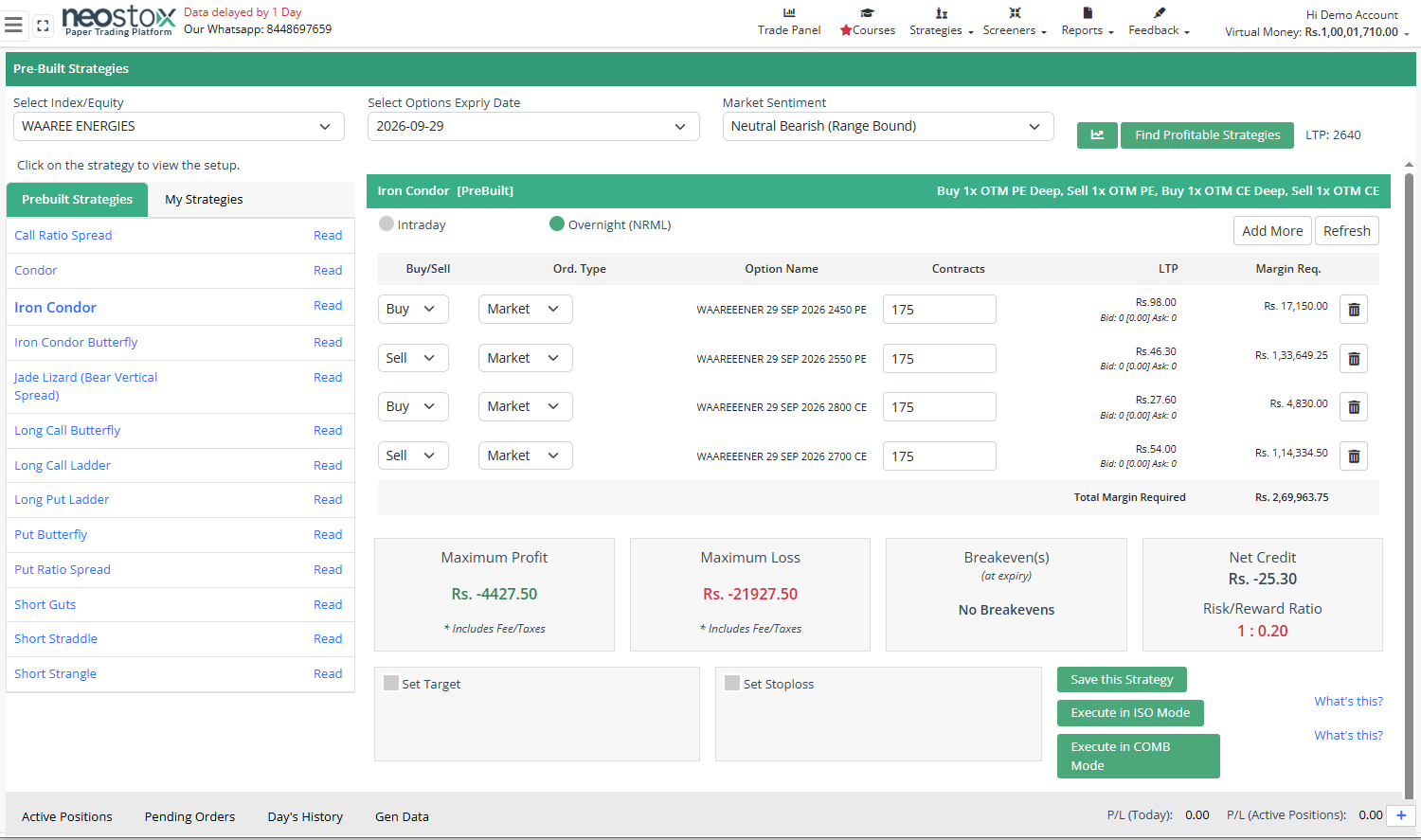
- Choose index or stock, expiry and a range-bound view — Iron Condor is already in the pre-built library
- Inspect and edit each leg, then read max profit, max loss, breakevens and risk/reward before sending
- Place all four legs together. Set a target and stop-loss. Repeat with virtual money until the structure feels familiar
- Start with ₹5L virtual cash. Top up if you need more. No real money, no demat linking

Quick Answers
Iron Condor, Asked Clearly
Examples on this page are hypothetical and for education only. They are not live prices, trade recommendations or investment advice. Market prices on Neostox are delayed by 30 days. Practice with virtual money.
Practice the Iron Condor on Nifty, BankNifty and Sensex — with virtual money.
₹5L virtual cash to start, real market prices, payoff and risk on screen before you send the four legs. No real capital at risk.